Do We Need A Democracy Tariff?

This post originally appeared at Campaign for America’s Future (CAF) at their Blog for OurFuture as part of the Making It In America project. I am a Fellow with CAF.
We need a Democracy Tariff, imposed at the border on goods that are brought in from countries where the people have not been able to build a strong democracy that protects their workers, wages and environment.
Yesterday in Exporting Jobs Is Not “Trade.” It Evades Democracy’s Protections I wrote that … well … exporting jobs is not “trade.” Packing up a factory here to send the jobs there, and then bringing the same goods that factory was making back here to sell is done for one and only one reason. It is done to get around the wage, safety and environmental protections that We, the People fought to build.
We formed this country and we fought to build protections that brought us a reasonably good life, and a middle class, and some security – social security – so we don’t always have to be struggling and living on the edge of a cliff, surviving only at the whim of a wealthy few with all the power. We fought a revolution against government by a wealthy and powerful few, and we fought again and again to keep and protect government of the people, by the people and for the people.
Our wage, safety and environmental protections are the result of our democracy. We, the People fought and built a government to empower and protect us, to provide good wages and provide some security and that involves rules that limit what the owners of companies can do — regulations. We build up a system of public structures like courts, laws, schools, roads, bridges — spending — that enable commerce to prosper. And we ask those who benefit from that commerce we enabled to share the return on our investment with us — taxes and wages.
Democracy, government, regulations, spending, taxes. The stronger each of these are, the better We, the People do. The weaker they are, the worse off we are.
Lately wealthy corporate owners — who benefit from the commerce that our democracy, government, regulations, spending and taxes enabled — have found another way to get around these protections that We, the People built for ourselves. They move manufacturing and jobs to countries where the people have not been able to build strong democracies to protect their interests, and then bring the goods made by the exploited workers there back here to sell. They call that “trade” when really it is just a way to get around the borders that we are able to protect. As I wrote yesterday,

These workers make the same products that had been made here, sell them in the same stores here, but make them outside of the boundaries of our democratically-won protections. And to make things worse, the companies then demand wage and benefit cuts from the workers who are still here, claiming that “globalization” means they now have to compete with workers with no rights, so they must accept less.

There is a solution to this problem. These protections that we built brought us prosperity. And that means we have a strong market. Everyone in the world wants to be able to sell to us, and we can use that power to set the rules for access to our markets.
A Democracy Tariff
We should not let exploitation of workers and the environment be a competitive advantage that is used against the democratic protections we have built for ourselves. We can and should set a “Democracy Tariff” on goods that come from countries that do not protect their workers and/or environment. This tariff should be enough to offset the competitive advantage that comes from exploiting workers and the environment. If those countries do not change we can use the revenue from the tariff to build our infrastructure and strengthen our competitive position. If those countries do change, all the better, because as democracy strengthens there, the people will prosper and can trade fairly with us to buy things we make here. Everyone is better off when trade is free and fair.
There are degrees of democracy and there can be degrees of Democracy Tariff. For example, some countries might protect workers but not the environment. The tariff on goods from those countries should be enough to offset the advantage gained from exploiting the environment but not as high as for countries that exploit both workers and the environment. Other countries might have some degree of protections but not allow unionization. The tariff should be enough to offset whatever degree of exploitation is at work.
If a Democracy Tariff is called “protectionism” so be it. We have learned the hard way that democracy is fragile and must be protected.
We must not allow exploitation of workers and the environment to be a “comparative advantage” used against our democracy — government of the people, by the people and for the people — and the protections and prosperity it has brought us.
Sign up here for the CAF daily summary.

Tax Cuts Leave Nothing Behind — Infrastructure Investment Leaves Behind Infrastructure

This post originally appeared at Campaign for America’s Future (CAF) at their Blog for OurFuture as part of the Making It In America project. I am a Fellow with CAF.
Actually, the title kind of says it all, no?
If we spend money on tax cuts, the next year we only have debt and pay interest on the debt. For a clear example, just look at the damage the Bush tax cuts have done to the country. They left behind worse than nothing — we had years of slow growth, and the cuts caused a massive deficit and debt that plagues us now. And, because we didn’t have the money to use to maintain the infrastructure we are that much further behind on that task now.
If we spend money on improving the country’s infrastructure, we get all the job creation that comes from that work, and the next year you have that infrastructure there to help drive the economy. For a clear example, how did all that government spending on the Interstate Highway System work out for the economy? For a clear example, look at China’s investment in high-speed rail. They can now move people and goods so much more efficiently and faster between their cities, and they developed an industry that is now selling its expertise to the rest of the world.
Our country has a huge, huge infrastructure deficit. After the Reagan tax cuts started draining the government’s ability to be a government we slowed down or stopped maintenance of the country’s roads, bridges, water and sewer systems, transit systems, schools, dams & levees and everything else that didn’t blow someone up. Our rail system is not last-century, it is century-before-last! The American Society of Civil Engineers calculates that we are $2.2 trillion behind where we need to be. As a result we have fallen behind the rest of the world in competitiveness, efficiency, and of course job creation.
Connect the dots: We have about 10% unemployment and we have a huge, huge backlog of work that needs doing. And after that work gets done the economy will run much more smoothly and will be much more competitive.
To me it’s a no-brainer. Everyone benefits when we invest in jobs and infrastructure. We can see all around us that tax cuts leave nothing behind, and in fact make our problems worse.
Sign up here for the CAF daily summary.
Alan Greenspan And Things Forgotten

This post originally appeared at Campaign for America’s Future (CAF) at their Blog for OurFuture. I am a Fellow with CAF.
Ah, the things we forget.
This was then: Federal Reserve Chair Alan Greenspan greenlighted the Bush tax cuts, saying that Clinton was paying down the country’s debt too fast as a result of modest taxes on the wealthy. So the Bush tax cuts for the rich passed, which immediately brought us the huge, huge deficits. Bush called the deficits “Incredibly positive news” because they would force a debt crisis.
In the 80’s Alan Greenspan’s Social Security Commission raised taxes and cut benefits on working people, providing a huge amount of revenue which was then handed out as tax cuts for the rich. And now, rather than pay back that money borrowed from Social Security from where it went, our elites are insisting that Social Security must be cut back, we must all work until 70, etc.
Decades earlier Alan Greenspan was smack in the center of the Ayn Rand* cult that called the non-wealthy “parasites,”

Mr. Greenspan had married a member of Rand’s inner circle, known as the Collective, that met every Saturday night in her New York apartment. . . . Mr. Greenspan wrote: “ ‘Atlas Shrugged’ is a celebration of life and happiness. Justice is unrelenting. Creative individuals and undeviating purpose and rationality achieve joy and fulfillment. Parasites who persistently avoid either purpose or reason perish as they should.”

This is now: Greenspan Calls for Congress to Let All Bush Tax Cuts Expire

Former Federal Reserve Chairman Alan Greenspan, whose backing of George W. Bush’s 2001 tax cuts helped persuade Congress to pass them, said lawmakers should allow the reductions to expire at the end of this year. “They should follow the law and let them lapse,” Greenspan said in an interview on Bloomberg Television’s “Conversations with Judy Woodruff,” citing a need for the tax revenue to reduce the federal budget deficit.

And there was his “I was wrong” testimony,

… a humbled Mr. Greenspan admitted that he had put too much faith in the self-correcting power of free markets and had failed to anticipate the self-destructive power of wanton mortgage lending.
“Those of us who have looked to the self-interest of lending institutions to protect shareholders’ equity, myself included, are in a state of shocked disbelief,” he told the House Committee on Oversight and Government Reform.

Alan Greenspan is in his 80s. He forgets — or at least wants us to forget. Don’t let anyone forget.
The debt crisis was the plan, right there for everyone to see:

  • Step 1: Cut taxes to “cut the allowance” of government so that it can’t function on the side of We, the People. Intentionally force the government into greater and greater debt.
  • Step 2: Use the debt as a reason to cut the things government does for We, the People. When the resulting deficits pile up scare people that the government is “going bankrupt” so they’ll let you sell off the people’s assets and “privatize” the functions of government. Of course, insist that putting taxes back where they were will “harm the economy.”

So don’t forget.
—
* One more thing not to forget. I mentioned Ayn Rand. Rand’s work is very popular among conservatives now. It forms a core justification for their “on your own” philosophy praising the wealthy and discarding the rest. So it is useful to explore the formation and core of this philosophy. Early in her writings Rand became fascinated with a serial killer named William Hickman. Rand wrote that the serial killer was an “ideal man,” a superior form of human because he didn’t let society impose their morals on him. He didn’t worry about what others thought and just did as he pleased.
“Other people do not exist for him, and he does not see why they should,” Rand wrote. Hickman had “no regard whatsoever for all that society holds sacred, and with a consciousness all his own. He has the true, innate psychology of a Superman. He can never realize and feel ‘other people.'” She considered these to be good qualities! And so does her cult.
This is the foundation of the modern “tea party” conservative thinking. So when you look at the modern capitalism that has grown up around Rand’s philosophy and the big corporations that are chewing up the planet to enrich a very few at the expense of the rest of us, and think it seems sort of psychopathic, maybe that’s because it literally is.
Sign up here for the CAF daily summary.

Make Them Work

This post originally appeared at Campaign for America’s Future (CAF) at their Blog for OurFuture. I am a Fellow with CAF.
Conservatives seem to think of America’s citizens as “the help.”
“Everyone knows Americans are lazy, shiftless, always looking for a way to shirk their responsibilities. People don’t want to work so we have to make them work. And good dose of humiliation is good for the soul. If you let them have any dignity they might get uppity.” That is what conservatives sound like when they talk about the long-term unemployed — who, by the way, are out of work because of conservative policies.
For example, from Tuesday’s WaPo, No extension of unemployment benefits in sight for the long-term jobless,

“Workers are less likely to look for work, or accept less-than-ideal jobs, as long as they are protected from the full consequences of being unemployed,” said Michael D. Tanner, a senior fellow at the Cato Institute, a libertarian think tank. “That is not to say that anyone is getting rich off unemployment, or that unemployed people are lazy. But it is simple human nature that people are a little less motivated as long as a check is coming in.”

That’s right, you have to make them work, or they’ll just sit around and wont be “productive.” They wont face up to the “consequences” of unemployment. These parasites will just suck the blood out of the producers. You hear language like this all the time from conservatives. The unemployed are “lazy,” or “on drugs” etc. They are not “productive.” They are mooching off the rest of us.
This is all in sharp contrast to the noble rich, who are an entirely different species biologically and spiritually. They are the “wealth producers” who we must treat with kid gloves and certainly not ask them to pay for their use of infrastructure or government services lest they decide to stop working. They just want to keep working, and what they do is so important, so pure, so necessary to the sustenance of the rest of us that they must be coddled at all times lest we lose their golden-egg magic touch!
Maybe this kind of attitude towards their fellow citizens comes from the slaveholder roots of conservatism. According to Robin L. Einhorn, author of American Taxation, American Slavery,

…Americans are right to think that our antitax and antigovernment attitudes have deep historical roots. Our mistake is to dig for them in Boston. We should be digging in Virginia and South Carolina rather than in Massachusetts or Pennsylvania, because the origins of these attitudes have more to do with the history of American slavery than the history of American freedom. They have more to do with protections for entrenched wealth than with promises of opportunity, and more to do with the demands of privileged elites than with the strivings of the common man. Instead of reflecting a heritage that valued liberty over all other concerns, they are part of the poisonous legacy we have inherited from the slaveholders who forged much of our political tradition. [emphasis added]

As for this idea of low taxes, smaller government that we hear about so often, (and please read this, it is so important)

It might seem strange to trace our antitax and antigovernment ideas to slavery instead of to liberty and democracy. Isn’t it obvious that a democratic society where “the people” make the basic political decisions will choose lower taxes and smaller governments? The short answer is no. In this democratic society, the people might decide to pool their resources to buy good roads, excellent schools, convenient courthouses, and an effective military establishment. But slaveholders had different priorities than other people—and special reasons to be afraid of taxes. Slaveholders had little need for transportation improvements (since their land was often already on good transportation links such as rivers) and hardly any interest in an educated workforce (it was illegal to teach slaves to read and write because slaveholders thought education would help African Americans seize their freedom). Slaveholders wanted the military, not least to promote the westward expansion of slavery, and they also wanted local police forces (“slave patrols”) to protect them against rebellious slaves. They wanted all manner of government action to protect slavery, while they tended to dismiss everything else as wasteful government spending.

Compromises with the slave states became entrenched in our political system with consequences to this day,

Majorities voluntarily renounced the right to regulate their society by majority rule. Giving up the essence of democratic self-government, they celebrated the outcome as democracy. The consequences would outlive the slaveholders who played such a large role in establishing this attitude toward government and taxation. Long after slavery was gone, a regime forged around preferential treatment for the slaveholding elite came to favor very different elites—commercial and industrial elites who shared little with their slaveholding predecessors except a demand that majorities renounce their right to govern what ostensibly was a democratic society.
. . . Today, this brand of politics looks eerily familiar. We have experience with political parties that attack “elites” in order to rally voters behind policies that benefit elites. This is what the slaveholders did in early American history, and they did it very well. Expansions of slavery became expansions of “liberty,” constitutional limitations on democratic self-government became defenses of “equal rights,” and the power of slaveholding elites became the power of the “common man.” In the topsy-turvy political world we have inherited from the age of slavery, the power of the majority to decide how to tax became the power of an alien “government” to oppress “the people.”

Please go read it all.
It is time to take a fresh look at what it means to be a citizen in a country where We, the People are supposed to be in charge. This idea that we should force people into demeaning jobs with no minimum wage and make them work seems antithetical to democracy. A government of We, the People should be about taking care of each other, protecting and empowering each other and respecting each other. You are supposed to be the boss of you here. And we are supposed to be in charge.
Sign up here for the CAF daily summary.

Wait, Who Said We Want Less Government Protecting And Empowering Us?

This post originally appeared at Campaign for America’s Future (CAF) at their Blog for OurFuture. I am a Fellow with CAF.
Cut spending? Wait – where did that terrible idea come from? Government is We, the People and its job is to protect and empower us. Why in the world would we want to cut back on that?
WSJ today, The Bush Tax Cuts and the Deficit Myth, “Runaway government spending, not declining tax revenues, is the reason the U.S. faces dramatic budget shortfalls for years to come.”
Wait a minute. Back up. Where did this come from? Who, anywhere, any time agreed to cut government? Why do We, the People allow these anti-government zealots to pre-frame the budget deficit as a problem of government doing too much for us? Which government function is the “too much” part? Reigning in runaway corporations? Consumer protection? Worker safety inspections? Food safety inspections? Maintaining and modernizing our infrastructure? Educating people? The courts? Keeping the water and air clean? There is a long list of things our government does for us. Why would we want less of that?
Imagine if Democrats voted to just put $500 billion a year in rockets and shot the rockets at the moon, and spent the next 30 years demanding that conservatives do their part and raise taxes to pay for that. Do you think the top 1% would just say, “OH, OK, let’s do that.” Of course they wouldn’t.
But under anti-government conservatives all of these things that our government does to protect and empower us were cut to the bone or just ended, resulting in mine disasters, bank meltdowns, predatory corporations scamming all of us, and the BP oil spill. We, the people got poorer and less secure while the rich got really, really richer.
Why would anyone in their right mind think that was a good idea?
Conservatives cut taxes on the rich, resulting in the greatest concentration of wealth ever. The entire economy turned into an everything-to-the-top vacuum cleaner scheme, filled with scams shaking down and fleecing We, the People of everything we have and delivering it to a few wealthy corporation-owners. And then we get this bamboozlement that “the deficit” is out of control, so we have to cut back on anything that remains of government working for We, the People? I don’t think so.
Think about the level of bamboozlement that is going on here. Conservatives cut taxes on the rich, and then spend the next 30 years saying, “OK, now you have to do your part and cut the things government does for the people.” The whole thing was a scheme to deliver power to a few at the top. In Reagan Revolution Home To Roost: America Drowning In Debt you can see the step-by-step outline of the plan, in their own words. The deficit plan was right there for everyone to see:

  • Step 1: Cut taxes to “cut the allowance” of government so that it can’t function on the side of We, the People. Intentionally force the government into greater and greater debt.
  • Step 2: Use the debt as a reason to cut the things government does for We, the People. When the resulting deficits pile up scare people that the government is “going bankrupt” so they’ll let you sell off the people’s assets and “privatize” the functions of government. Of course, insist that putting taxes back where they were will “harm the economy.”
  • Step 3: Blame liberals for the disastrous effects of spending cutbacks.

So when did We, the People agree to this one-way bargain, cut taxes for the rich and cut what government does for us? We didn’t, and we should stop acting like we did.
Every single one of us knows that the deficits are the result of tax cuts for the rich and huge military spending increases. If we want to fix the deficit problem we know exactly what to do.
Sign up here for the CAF daily summary.

Deficits: Get The Money From Where The Money Went

This post originally appeared at Campaign for America’s Future (CAF) at their Blog for OurFuture. I am a Fellow with CAF.
McClatchy news story, No full Social Security benefits until age 70?

Young Americans might not get full Social Security retirement benefits until they reach age 70 if some trial balloons that prominent lawmakers of both parties are floating become law.

Don’t fall for it. Social Security did not contribute to the deficits or debt, it ran a huge surplus. That surplus was supposed to be set aside. Instead it was handed out to the very wealthy as tax cuts. Now the country needs to start paying it back to the elderly, and to prevent us from getting it back from where it went — the wealthy few — they’re instead talking about making people wait until age 70 to retire, cutting benefits, etc.
Every one of us knows that the budget deficits come from the tax cuts and military spending increases of recent decades. But every one of us also knows that the beneficiaries of those tax cuts and military spending use their wealth and power to corrupt the political system, preventing us from restoring sanity to our governance.
Before the tax cuts on the top rates and military spending increases we didn’t have these deficit/debt problems, we maintained our infrastructure, provided educations, we even spent enough on our military to oppose the Soviet Union globally. The country worked better then. When top tax rates were cut from 90% the result was immediately deficits, then under Reagan came the really big cuts that led to the “structural” deficits and the huge debt increases and resulting interest load.
Since those tax cuts we have seen so many transformations for the worse. The wealthy now dominate every single part of our politics. Instead of having to build a fortune over time people can now reap a windfall from quick buck schemes — so that is what people focus on. When upper income was taxed at a high rate people built equity over time that, when sold, was taxed at only half that rate, and people became wealthy. When it took time to build a fortune companies had long-term strategies that depended on serving customers, solid surrounding communities with solid infrastructure, supply chains, experienced workers, etc. Now you can make your fortune selling off those things and pocketing the proceeds.
Those tax cuts were the direct cause of the deficit and debt problem. The military increases are a second cause of the problem. Social Security was never a cause of the problem. The clear way to fix the problem is to restore those tax rates and cut the military budget to pre-Cold War levels. The Soviet Union is long gone.
So what do we do about it?
What can we do about this? Learn the facts. This is a strategic assault on Social Security that has been underway for a long time.
Spread the word. Tell everyone that Social Security did not contribute to the deficit, tax cuts for the wealthy and military spending are the reason we have these deficits and raising taxes at the top and cutting military spending will do much more than cutting Social Security to help solve the problem.
Start calling members of Congress and telling them we will not tolerate Social Security cuts. Tell everyone you know, family members, friends and everyone else to call.
Join Social Security Works.
Sign up here for the CAF daily summary.

Conservatives Call For Massive Deficit Spending To Create JOBS

This post originally appeared at Campaign for America’s Future (CAF) at their Blog for OurFuture. I am a Fellow with CAF.
Saying that the Obama “stimulus” was not big enough, conservatives are demanding that the government massively increase deficit spending to create badly-needed jobs. Newt Gingrich, at the conservative media outlet Human Events, calls for an Economic Freedom Act that includes,

• Reducing the payroll tax by half for 2010…;
• Eliminating the capital gains tax …;
• Reducing the corporate tax rate to 12.5% …;
• Permanently eliminating the death tax … ; [note – what he refers to as a “death tax” is an income tax on wealthy children – DJ]

Each of these tax cuts demanded by conservatives would greatly increase the deficit. Many other conservative organizations and politicians are joining this demand for massive deficit spending to create jobs.
In the article, Gingrich also criticized the size of the Obama stimulus because it did not create enough jobs, writing, “The Obama stimulus has clearly failed. It’s time to get back to what we know works for job creation. 2+2=4.”
Gingrich was right that the stimulus was insufficient. The CBO recently reported that the stimulus put up to 2.8 million people to work, lowered the unemployment rate by up to 1.5% and boosted the GDP by up to 4.2%. But the conservative-created job and recession crisis is much, much worse than that. We need emergency action to create 10 million jobs!
Tax cuts are the wrong approach because they would also reduce the country’s ability to maintain and modernize the infrastructure while increasing the problem of extreme concentration of wealth. Economists say that tax cuts are not effective at creating jobs (and create structural deficit problems), while directly creating jobs through infrastructure investment also leaves behind … badly-needed infrastructure.

Tax Cuts Caused The Deficits, Therefore…

This post originally appeared at Campaign for America’s Future (CAF) at their Blog for OurFuture. I am a Fellow with CAF.
No serious person denies that Reagan’s 1981 tax cuts and military increases threw the country into a pattern of borrowing and borrowing that we have not escaped. When Reagan took office the national debt was $995 billion. When Reagan left office it was $2.87 trillion and climbing fast.
No serious person denies that Bush’s 2001 tax cuts and continued military increases dramatically worsened the problem. Bush’s last budget year ended with a record single-year deficit of $1.4 trillion.
As the country discusses what to do about the borrowing the elephant in the room is that everyone understands that restoring top tax rates to pre-Reagan levels and cutting the military budget in half would solve the problem completely. But we can’t do that. We can’t even discuss it.
And we all know why. And we all know why. It is because the Reagan Revolution transformed the country from a democracy to a plutocracy — a country run by and for the wealthy.
Such sensible and simple ideas are considered off-limits. To even bring up the idea of restoring tax rates to pre-Reagan levels and cutting military spending invites terrible consequences. The speaker risks becoming the target of the money’s noise machine: Limbaugh, Hannity, Drudge, Fox. Smears. Humiliation. Banishment. Or the noise machine cranks up a campaign of misinformation, convincing people –especially DC people — that what they see in front of their eyes just isn’t so. Repeat it enough and it becomes solid knowledge.
We all know this is the way it is. So don’t tell me that “we don’t have the money” to keep 300,000 teachers from being laid off, or to help the long-term, mostly older unemployed workers get something to live on and keep their health care. The money is right there in front of us, but the Congress is bought and paid for.
What do we do? We have to demand representatives who represent us, not make excuses for representing the wealthy. The unfortunate, poor and disadvantaged must count every bit as much as the privileged — that’s what democracy means. And we have to be ready to turn them out if they don’t. For our part, we have to pay attention and demand to be shown, not told. We have to become citizens, not consumers.

Reagan Revolution Home To Roost – America Drowning In Debt

This post originally appeared at Campaign for America’s Future (CAF) at their Blog for OurFuture. I am a Fellow with CAF.

“Watch what we do, not what we say.” (Famous Republican advice.)
The Reagan Revolution was first and foremost about cutting the taxes paid by the rich and corporations. Now, almost 30 years later, the United States of America is drowning in debt. And that is exactly what they wanted to happen.

The Plan

There were the reasons for the tax cuts Reagan said, and there was the plan Reagan had. Reagan SAID that there was this thing called the “Laugher Curve” that he said proved cutting taxes would actually increase government revenue. But what they were saying was a smokescreen, something to tell the rubes. Increasing government revenue was the last thing Reagan and his cohorts wanted. They knew (and have since said so) cutting taxes would lead to terrible deficits. They called this a “strategic deficit.” This was the plan.

Bankrupting our government (We, the People) was the plan and today we can see that it was what they did. They didn’t want revenue to increase because the idea was to “starve the beast.” Reagan called it “cutting their allowance.”
The plan was that by cutting the funding for government, government would have to cut back on what it does: regulating business, protecting regular people against powerful interests, building infrastructure, educating kids, taking care of the poor and elderly. With government (We, the People) out of the way businesses could be unleashed and really start to make money. And for those who could afford to pay, private companies would take over those other functions. That was called “privatization.”

Infrastructure? We had plenty of infrastructure back then – grab the cash now and worry about that later. (It’s later now.)

So taxes were cut. And immediately the budget went into deficit and the government started borrowing. The debt started to grow. That was the plan. They said so.

Conservatives well understood that the public was not behind their plan. This was why it was explained as a way to increase government revenue. “Watch what we do, not what we say” is about tricking the public – deceive people by telling them you are doing one thing while really doing another. They knew that if the public came to understand their plan they would all be voted out of office. The idea was to force the other party to make the cuts.

Every time someone did try to cut the public outcry was enormous. So they just kept borrowing, intentionally trying to make the debt get so bad that eventually the government would be faced with bankruptcy.

Clinton, for a time, foiled their plans. In 1993 there was a hard-fought battle to raise taxes at the top by just a small amount. Every Republican voted against it. The public was saturated with lie after lie about how this would destroy the economy. Of course, the economy boomed in the 1990s following the Clinton tax increases and by the end of Clinton’s term the government was paying off debt so quickly that Alan Greenspan called for Bush II to again cut taxes on the rich, saying it was dangerous to pay off the government debt – yes, the same Alan Greenspan who now says we have to get rid of Social Security to pay off debt. The plan.

Bush called restoration of deficits “incredibly positive news”

Seven months after taking office, George W. Bush learned that his budgets had already erased the previous administration’s huge surplus — that was paying off our country’s debt at a rapid rate — and had instead forced the country to start borrowing heavily again. Bush said the huge deficit was “Incredibly positive news” because it will create “a fiscal straitjacket for Congress.” That’s right, massive deficits were “incredibly positive news.” The plan.

Deficit hawks today

Now we’re experiencing part two of The Plan: use the debt as a reason to cut the things government does for We, the People. The deficit cutters insist that the government should cease investment in infrastructure, educating kids, taking care of the poor and elderly and protecting regular people against powerful interests. First and foremost they want to cut Social Security. They blocked a reasonable health care plan in the name of “less spending.” They fight every effort to stimulate the economy and create jobs so that We, the People can get out of this unemployment emergency. (High unemployment puts tremendous wage pressure on the remaining workers.)

Are we going to fall for it? Are we going to walk right into part two of The Plan? Or are we going to restore the tax base, which is the lifeblood of democracy. Taxes on the wealthy and big corporations are what brings the ability of We, the People to control our own destiny instead of yielding always to the powerful interests.

This is the choice we are faced with. The “deficit hawks” are offering only The Plan. So far restoring the tax base back to where it was is off the table, not even to be discussed. Are we going to allow that? Or are We, the People going to fight back and demand that democracy be restored?
Previously: Reagan Revolution Home To Roost: America Is Crumbling and Finance, Mine, Oil & Debt Disasters: THIS Is Deregulation

The Odd Logic Of Deficit-Cutting Arguments

This post originally appeared at Campaign for America’s Future (CAF) at their Blog for OurFuture as part of CAF’s ongoing “Virtual Summit on Fiscal and Economic Responsibility for People Who Did Not Wreck The Economy.” I am a Fellow with CAF.
Have you noticed that there is a very odd logic around the DC Beltway deficit-cutting frenzy? Here is the basic argument:
A) Things worked great back when taxes on the rich were high. We built up the infrastructure that made us prosperous, and we built up a middle class. We didn’t have budget deficits. There were many other benefits to the economy, society and our democracy. They were America’s golden years.
B) Then we cut tax rates for the rich and massively increased military spending. Since then — and because we did those things — the budget and the economy have gone to pot. We had to cut education, stop maintaining the infrastructure, and cut all kinds of things that benefit regular people and make the economy grow. Wealth has concentrated at the very top, and regular people are falling further and further behind. The budget cuts made us “eat the seed corn” and now the country has lost its competitive edge in the world’s economy.
You would think people would be able to connect the obvious dots and come to the obvious conclusion about how to fix the problem. But instead the odd logic of the deficit cutters leads them to the strangest of strange conclusions about how to fix the problem:
C) Therefore we have to cut spending even more on things that benefit regular people and grow the economy (and especially on Social Security for the elderly). But we must not touch spending on the military even though we spend more than all other countries on earth combined, and military spending hurts the economy. Raising taxes on the rich back where they were before cutting them started all the trouble is flat-out off the table.
But … but … but …
As Homer Simpson would say, “D’oh!”
Sign up here for the CAF daily summary.

Reagan Revolution Home To Roost: America Is Crumbling

This post originally appeared at Campaign for America’s Future (CAF) at their Blog for OurFuture as part of the Making It In America project. I am a Fellow with CAF.
The conservative argument of the last 30-40 years boils down to this: “Hey look at this big pile of seed corn. Let’s eat it!” Almost 30 years after the “Reagan Revolution” our infrastructure is crumbling around us. Since the Reagan-era tax cuts we have been deferring maintenance of (and never mind modernizing) our infrastructure, and as a result have become less competitive in the world economy.
Meanwhile our economic competitors, countries like China and India, have been building infrastructure like crazy. Other countries are investing, educating, improving public services because they know these things make the economy explode later. A major component of China’s stimulus was infrastructure and public services – including public welfare – because of the economic benefits that come later.
Now for those countries it is later, while for us it’s just becoming too late. Their investment is paying off while we’re having trouble paying off the accumulated Reagan/Bush tax-cut debt.
How did we get here?
Public infrastructure is the roads, courts, education, etc. that enable an economy to prosper. We got ourselves out of the Great Depression with a big investment in public infrastructure. The government taxed the wealthy and built or improved modern roads, bridges, post offices, courthouses, shipyards, schools and other public structures that enabled business to take off.
And then business took off. The idea was, of course, that business would give back some of the returns to keep that process going. But instead the big companies and wealthy families funded a conservative propaganda machine that convinced people to let them just keep it. Look at this chart from 14 Ways A 90 Percent Top Tax Rate Fixes Our Economy And Our Country:

krugman_chart

You can clearly see that the money that should have been invested in maintaining and modernizing our infrastructure instead has gone to a few wealthy people at the top of the food chain. (We’re the food.) And of course, we all can clearly see the results of this in today’s economy. They ate the seed corn, America is crumbling.
Now, here we are later and we are seeing the result of the Reagan Revolution. The American Society of Civil Engineers (ASCE) Infrastructure Report Card estimates that we are $2.2 trillion behind just on maintaining the existing infrastructure, never mind modernizing. Please click through and explore what ASCE is saying there. (Conservatives — there are lots of pictures!)
What do we do?
The answer is obvious. It is called public investment. Ask the big companies, the banks and the wealthy to pay back some of the incredible amounts of money they have been piling up as a result of the past investment that We, the People made in building that infrastructure that enabled the economy to boom. Use that money to invest in maintaining and modernizing the infrastructure so that the economy can again thrive for all of us.
We can employ the unemployed and bring our infrastructure up to par at the same time. There is a lot of work that needs doing and we have a lot of people out of work.
The payback will be enormous. The economy will explode. And we can build sustainability into the process this time.
What is in the way?
The problem now is that the corporate/conservative propaganda machine has gone way past talking people into cutting taxes for the rich and cutting back on public spending for infrastructure and our people. Now they have become very extreme, convincing a number of people that government spending – We, the People spending on the common good – and government itself – We, the People making the decisions for ourselves – is the wrong approach. They believe that any government at all is “socialism” — run for the benefit of all of us — and that all public services must be “privatized” — meaning run for the benefit of a few. They believe it is wrong, even immoral to have public schools, public transit, public health care, regulations that restrict what companies can do to consumers or the environment, etc.
They have the megaphone because they have the money. We have to confront this head on.
More to come!
This is another story of a wealthy few selling off the country’s people and future. This is another story of gains for a few at the expense of the rest of us. These stories are becoming all too common. This is the Reagan Revolution coming home to roost, and I will continue to write about the terrible price we are paying and will be paying for a long time for the failed experiment in conservative ideology.
Sign up here for the CAF daily summary.

14 Ways A 90 Percent Top Tax Rate Fixes Our Economy And Our Country

A return to Eisenhower-era 90% top tax rates helps fix our economy in several ways:

1) It makes it take longer to end up with a fortune. In fact it makes people build and earn a fortune, instead of shooting for quick windfalls. This forces long-term thinking and planning instead of short-term scheming and scamming. If grabbing everything in sight and running doesn’t pay off anymore, you have to change your strategy.

2) It gets rid of the quick-buck-scheme business model. Making people take a longer-term approach to building rather than grabbing a fortune will help reattach businesses to communities by reinforcing interdependence between businesses and their surrounding communities. When it takes owners and executives years to build up a fortune they need solid companies that are around for a long time. This requires the surrounding public infrastructure of roads, schools, police, fire, courts, etc., to be in good shape to provide long-term support for the enterprise. You also want your company to build a solid reputation for serving its customers rather than cheapening the product, pursuing quick-buck scams, cutting customer service, etc. The current Wall Street/private equity business model of looting companies, leaving behind an empty shell, unemployed workers and a surrounding community in devastation will no longer be a viable business strategy.

3) It will lower the executive crime rate. Today it is possible to run scams that let you pocket huge sums in a single year, and leave behind the mess you make for others to fix. A high top tax rate removes the incentive to lie, cheat and steal to grab every buck you can as fast as you can. This reduces the temptation to be dishonest. If you aren’t going to keep the whole dime, why risk doing the time? When excessive, massive paydays are possible, it opens the door to overwhelming greed and a resulting compromising of principles. Sort of the definition of the decades since Reagan, no?

4) Combined with badly-needed cuts in military spending – we spend more on military than all other countries on earth combined – taxing the wealthy ends budget deficits and starts paying off the massive Reagan/Bush debt. This reduces and ultimately eliminates the share of the budget that goes to pay interest. The United States now has to pay a huge share of its budget just to cover the interest on the borrowing that tax cuts made necessary. Paying off the debt would remove this huge drag on our economy. (Never mind that Alan Greenspan famously called for Bush’s tax cuts by saying it was dangerous to pay off our debt – now that same Alan Greenspan says we need to cut benefits to retired people because our debt is so high.)

5) It will bring in revenue to pay for improvements in infrastructure that then cause the economy to explode for the better. Investing in modern transit systems, smart grid, energy efficiency, fast internet and other improvements leads to a huge payoff of increased prosperity for all of us – especially for those at the top income levels. Infrastructure improvement and maintenance is the “seed corn” of economic growth. We have been eating that seed corn since Reagan’s tax cuts.

6) (related) It will bring in revenue for improving our schools, colleges and universities. Not only will this help our competitiveness, but it will improve each of our lives and level of happiness.

7) It will boost economic growth and rebuild a strong middle class. A consumption-based economy does better when consumers have more to spend. Perhaps not cause-and-effect, though I suspect so, but after FDR raised top tax rates the economy grew dramatically. The 90% top rate years under FDR, Truman, Eisenhower and the beginning of the Kennedy years were the years when we built the middle class. And remember, after Clinton raised top tax rates only modestly the economy grew. How’s it been doing since Bush’s tax cuts for the rich?

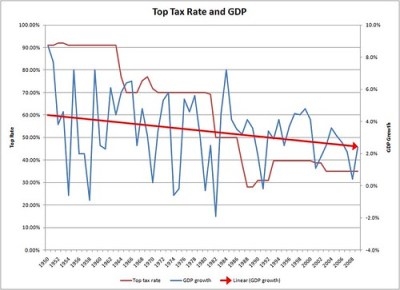
A look at economic growth rate charts shows a steady decline in the decades since top tax rates began to fall. Is it just a coincidence that the economy booms after tax increases that provide revenue to invest in new “seed corn,” and that the economy declines as we reduce taxes?

8) It is good for business because increased revenue will enable increasing government spending for the benefit of regular people. This recirculates money into the economy more productively than the current system of putting huge fortunes into a few hands and hoping for a resulting consumption of high-end goods. The wealthy can only spend so muc h so more disposable income in the hands of regular people is good for business. Any business owner will tell you they want customers more than they want tax cuts. (Let’s wait until the top one percent no longer owns most of everything before we talk about whether there is an effect on investment.)

9) It protects working people. Exploiting workers with long hours, low pay or lack of pay increases, lack of worker protections, firing union organizers and schemes that call employees “contractors” will no longer pay off as it does today. The era of extreme union-busting came in at the same time as the tax cuts.

Krugman:

The chart shows the share of the richest 10 percent of the American population in total income – an indicator that closely tracks many other measures of economic inequality – over the past 90 years, as estimated by the economists Thomas Piketty and Emmanuel Saez.

10) It redistributes income and wealth in ways that help all of us. Currently a few people receive most of the income and own most of everything. A very high top tax rate reduces this concentration of wealth.

11) It fights the political instability that results from concentration of wealth. Great inequality in a society and the resulting loss of opportunity results in political instability that can lead to extreme ideologies, rebellion, etc. We are seeing all the signs of a resurgence of these problems today.

12) It will help rebuild our sense of democracy and belief in equality. As we have seen and are seeing, when too much is in the hands of too few, they have too much power and influence and use it to get even more.

13) It will strengthen the government that We, the People have worked hard to build, and strengthen its ability to enforce the laws and regulations that protect all of us and the resources we hold in common. It will increase its ability to provide all of us equally with the benefits of our joint efforts and our economy.

14) Finally, for good measure, increasing top tax rates will cause those affected to work harder to make up the difference. The Ayn Randians claim the very rich are the “producers” and all the rest of us are just parasites and slackers who feed off their “work.” So it will be very good for our economy to get them working harder by taxing them at 90%! You may have heard about those 25 hedge fund managers who brought in an average of $1 billion each last year – an amount that would have paid for 658,000 teachers — while the rest of the country suffered through a terrible economy. If we had a top tax rate of 90% they would “only” take home $100 million or so each – in a single year. And we could have 658,000 more teachers. So it’s a win-win.

Taxes are how we all pitch in to enjoy the benefits and protections of modern society. Those benefits and protections are what enable people to become wealthy, and we ask that they give some back so others can prosper as well.